
 German
  English
  Russian
  Italian
  Japanese
  Korean
With the continuous development of high-end manufacturing, industries such as precision electronics, medical devices, aerospace, defense, and automotive electronics have placed increasingly higher requirements on surface protection. Protective coatings are now expected to provide excellent insulation, moisture resistance, and corrosion resistance, while also being ultra-thin, uniform, dense, and capable of covering complex structures, micro-gaps, and irregular surfaces.
Under these application demands, Parylene coating equipment has become an important process solution for high-reliability protection.
Parylene coating equipment, also known as Parylene vacuum chemical vapor deposition equipment or Parylene CVD coating equipment, is specialized vacuum process equipment designed for the preparation of poly-para-xylylene, namely Parylene, polymer protective coatings.
The equipment adopts a vacuum vapor-phase polymerization process to form an ultra-thin, transparent, conformal, uniform, pinhole-free, and dense protective film on the surface of workpieces. It is widely used in industries with extremely high reliability requirements, including precision electronics, medical devices, aerospace, and defense.
1. Parylene Coating Is Not Spraying — It Is a Film “Grown” in Vacuum
Parylene coating is fundamentally different from traditional spraying, dipping, or brushing processes.
Traditional coating methods usually rely on liquid materials covering the product surface. They are easily affected by surface tension, fluidity, dead corners, and complex geometries, which may result in uneven coating thickness, edge build-up, or poor coverage in micro-gaps.
Parylene coating, by contrast, is carried out in a vacuum environment. Through a chemical vapor deposition reaction, Parylene material enters the workpiece surface in the form of active molecules and polymerizes directly on the surface.
In simple terms, a Parylene coating is not “applied” onto the workpiece; it is grown in situ on the surface.
This is why Parylene coatings can provide excellent conformal coverage. They uniformly encapsulate complex structures, sharp edges, holes, gaps, and micro-clearances, forming a continuous and stable protective film.
2. Core Process Flow of Parylene Coating Equipment
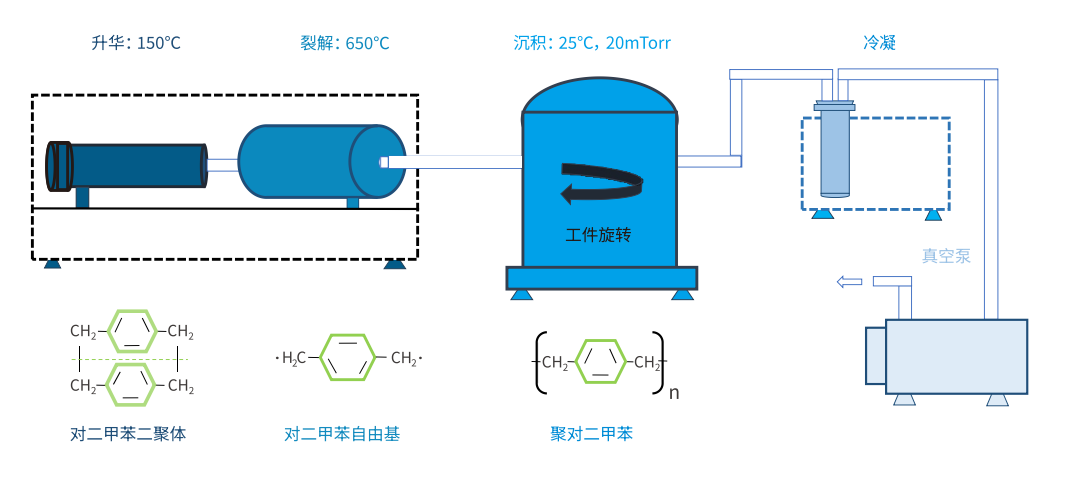
The design of Parylene coating equipment fully follows the vacuum chemical vapor deposition process of Parylene. The entire process mainly includes four key steps: sublimation, pyrolysis, deposition polymerization, and condensation recovery.
2.1 Sublimation: Converting Solid Parylene Material into Vapor
First, solid Parylene material is placed in the sublimation chamber.
Under vacuum and controlled temperature conditions, the solid Parylene material gradually sublimates into vapor, providing a stable vapor-phase raw material for the subsequent pyrolysis reaction.
This process requires precise control of temperature, vacuum level, and material feeding quantity to ensure a stable and continuous vaporization process.
2.2 Pyrolysis: Converting Vapor Molecules into Active Monomers
The sublimated vapor molecules then enter the pyrolysis chamber.
At a higher temperature, the Parylene dimer molecules are pyrolyzed, their chemical bonds are opened, and reactive monomer molecules, also known as free radicals, are formed.
The high temperature provides sufficient energy for the molecules to transform from dimers into active monomers, which is a critical step for subsequent polymerization and film formation.
2.3 Deposition Polymerization: Forming a Continuous Film on the Workpiece Surface
The pyrolyzed active monomers enter the deposition chamber.
At room temperature or under suitable process conditions, the active monomers undergo polymerization on the surface of the workpiece, gradually transforming from free radicals into a polymer and ultimately forming a continuous, dense, and uniform Parylene protective film.
At this stage, film thickness is closely related to the polymerization process. In general, a thicker coating corresponds to a higher degree of polymerization. By precisely controlling material dosage, chamber pressure, deposition time, and other process parameters, Parylene coatings with different thickness requirements can be achieved.
2.4 Condensation: Collecting Exhaust Vapor for a Clean Process
After deposition is completed, unreacted vapor enters the cold trap system.
Through low-temperature condensation in the cold trap, the exhaust vapor is collected and captured, reducing the impact of impurities and by-products on the system and enabling a clean process with no waste gas emissions.
3. Main Components of Parylene Coating Equipment
From the perspective of the process flow, the core structure of Parylene coating equipment mainly includes:
Sublimation chamber, pyrolysis chamber, deposition chamber, condensation system, vacuum pump system, heating and temperature control system, pressure control system, and automated control system.
During equipment operation, Parylene material first enters the equipment through the material feeding inlet. The amount of raw material is precisely controlled to ensure coating thickness and deposition stability.
Next, the vacuum system establishes a stable vacuum environment, while the heating and temperature control system separately controls the temperatures of the sublimation chamber, pyrolysis chamber, and deposition chamber, enabling the material to complete sublimation, pyrolysis, and deposition polymerization in sequence.
Finally, the cold trap and collection system captures unreacted by-products and impurities, ensuring that the entire process system remains stable, clean, and controllable.
4. Dynamic Chamber Design and High-Precision Control for Molecular-Level Coating
The key advantage of Parylene coating equipment lies in its ability to achieve molecular-level precision coating through intelligent temperature control, dynamic chamber design, and high-precision pressure control.
The equipment adopts a dynamic chamber design and works with dedicated tooling fixtures, allowing active monomers to fully enter complex structural areas on the workpiece surface and achieve 360° dead-angle-free encapsulation.
Even micro-gaps, holes, or complex irregular structures can be effectively penetrated and coated. Parylene material can enter and form a complete film even in micro-gaps of approximately 10 μm.
This is also one of the key reasons why Parylene coating is widely used in precision electronics, sensors, medical devices, and aerospace components.
5. Automated Control System for Improved Process Stability and Production Efficiency
Modern Parylene coating equipment is required not only to complete basic film-forming processes, but also to meet the demands of stability, traceability, and intelligent management in mass production.
The equipment is equipped with a full-process automated control system, which can monitor key parameters in real time, including sublimation temperature, pyrolysis temperature, deposition pressure, vacuum status, and cold trap temperature.
The system also supports real-time data recording and waveform visualization, helping users trace process parameters, analyze the process, and optimize future production.
With multi-level permission management and an intuitive operating interface, the equipment can effectively reduce manual operation errors and improve process consistency.
In addition, the equipment adopts an upper computer control system and is equipped with remote monitoring functions, enabling remote viewing and management of the production process. Under appropriate conditions, it can support “unattended” operation, greatly improving production efficiency.
6. Core Advantages of FANGCUNDA Parylene-Beschichtungsanlagen
Shenzhen FCD Technology Co., Ltd. has independent Parylene material R&D capabilities and is the only enterprise in China to achieve full industrial chain coverage across materials, equipment, and coating processing. Therefore, FANGCUNDA has an in-depth understanding of the physical and chemical properties of Parylene powder materials.
This enables FANGCUNDA to precisely match equipment process parameters according to different Parylene material characteristics, thereby improving coating stability and film consistency.
In practical applications, FANGCUNDA can control coating uniformity deviation within ±5%, which is far better than the industry average.
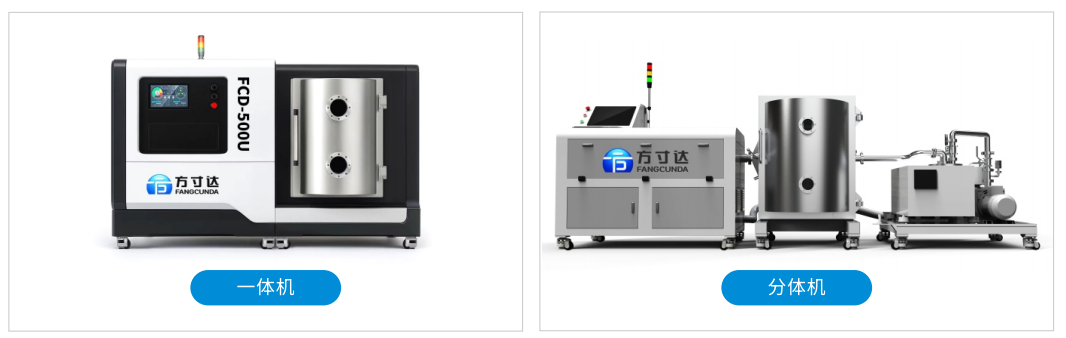
At the same time, FANGCUNDA’s self-developed Parylene coating equipment can adopt either an integrated or segmented design. The chamber volume can be flexibly customized according to customer requirements, meeting personalized needs in production capacity, transportation, installation space, and process layout.